A tool library for an apartment building: the starter list, the rules, and $24 a unit
Twelve tools most apartments need a few times a year, bought once for the whole building. What the starter list costs, how to split it, where it lives, and the rules that keep it full.
The AllDibs team
6 min read
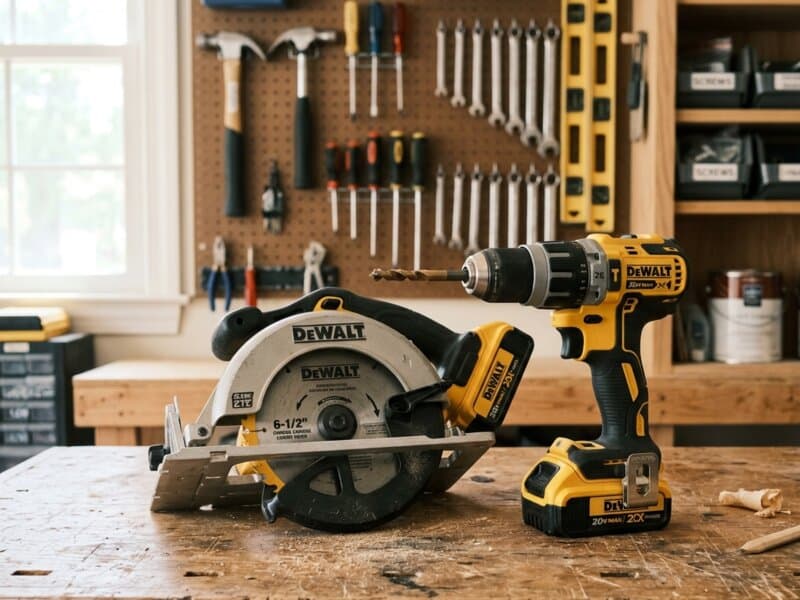
Every apartment building has the same drill in it thirty times. It lives under a sink or on a closet shelf, it gets used to hang a mirror and assemble a bookcase, and then it waits a year. The ladder is worse, because it takes up a closet that the apartment did not have to spare.
A tool library fixes that. The building buys one good set, keeps it somewhere everyone can reach, and residents borrow what they need for a few days at a time. This post is the practical version: what goes in the first set, what it costs per apartment, where it can live, and the handful of rules that decide whether it is still full in a year.
The starter list
Start with the things renters actually need and rarely own. That means hanging and assembling, cleaning up after a spill, moving furniture, and clearing a slow drain. Skip anything that needs a workshop. A table saw has no business in a basement storage room shared by forty households.
| Item | Price |
|---|---|
| Cordless drill and driver, two batteries | $150 |
| Drill bit and driver bit set | $30 |
| Hand tool kit: hammer, screwdrivers, pliers, tape measure, wrenches | $80 |
| Stud finder | $30 |
| 24-inch level | $25 |
| Six-foot step ladder | $120 |
| Shop vacuum | $100 |
| Carpet and upholstery spot cleaner | $130 |
| Hand truck | $80 |
| Two furniture dollies and moving straps | $40 |
| Hand drain auger, 25 feet | $40 |
| Two six-foot folding tables | $120 |
| Starter set | $945 |
Split across a 40-unit building where every apartment chips in, $945 is about $24 a unit. Few buildings get everyone. If fifteen households join, it is $63 each, which is still less than most of them would pay for the drill and the ladder alone. Price out the four things a single apartment is most likely to buy for itself, the drill, the hand kit, the ladder and the shop vacuum, and it comes to $450 on this list.
Add a small yearly budget for the things that wear out or go missing. Drill bits disappear, a battery dies, a vacuum filter clogs. Setting aside about 15 percent of the starter cost, roughly $140 a year, covers that on most years. Across fifteen households it is under $10 each. If you want to test whether any one item earns its place, run it through the cost per use calculator with how often the building really uses it.
Where it lives
This is the question that kills most building tool libraries before they start, so answer it first. Three places tend to work.
- A locked cabinet in a shared space, like the laundry room or a bike room, with a combination lock whose code goes only to people who joined. A cabinet sized for the list above costs a couple of hundred dollars and needs management's permission to install.
- A storage room the building already has, if management will give up a corner. This is the best version, because the ladder and the hand truck fit without anyone giving up a closet.
- One volunteer's apartment, which works for a small building and a short list, and fails the first time the volunteer goes away for two weeks in moving season.
Whichever you choose, talk to the landlord or the board before anyone buys anything. Ask whether a shared cabinet is allowed, who is responsible if a borrowed tool damages a wall, and whether the building's insurance cares. A manager may well like the idea of fewer residents improvising with a butter knife, but they will want to be asked first.
The rules that keep it full
A building tool library does not fail because people steal from it. It fails because nobody knows who has the ladder, the drill comes back with a dead battery, and the person who set it up gets tired of chasing. Every rule below is aimed at one of those three things.
- Three days, then it comes back. Long enough to finish a weekend project, short enough that the next person is not waiting a week. Moving gear is one day.
- Write it down when it leaves. A printable tool sign-out sheet taped inside the cabinet door is enough for most items.
- Return it charged and clean. Batteries on the charger, the vacuum emptied, the spot cleaner tank rinsed. The next person should not have to clean up after the last one.
- Report broken, do not hide it. A tool that breaks in normal use is the library's cost, paid from the yearly budget. A tool lost or broken through carelessness is the borrower's to replace. Say so up front, and people report things.
- One buy-in, then a small yearly top-up. New residents pay the same share as the founders did, which keeps the budget fair as the building turns over.
- One named keeper. Not to police anything, just to reorder bits, check the batteries once a month and hold the code. Rotate it every year so it never becomes one person's job forever.
Resist the urge to write more rules than that. A two-page policy taped to a cabinet tells people the library is a hassle, and they go back to buying their own drill. The same lesson holds on an ordinary street, where the things worth owning once instead of twelve times look a lot like this list.
Start small, then grow it
You do not need all twelve items on day one. A drill, a hand kit and a ladder cover most of what apartments need, and they cost $350 on the list above, or $380 with the bit set. Buy those, see who borrows them, and let the sign-out sheet tell you what to add next. If the shop vacuum gets asked for three times in the first month, buy one. If nobody ever asks about the drain auger, leave it off.
The drill is the right first item for another reason. It is the tool most apartments already own and almost never use, which is the whole argument in the drill you use twice a year. The more residents who realize theirs could go in the cabinet, the faster the library pays for itself, because donated tools cost nothing.
The sheet is fine until the 31st
A paper sheet works for a drill nobody is competing for. It stops working for the hand truck at the end of the month, when three apartments are moving out and each one assumed it would be there. That is when a building needs to see who has a thing and who has asked for it next, without knocking on doors.
AllDibs gives the building that calendar. Each household books what it needs, sees what is already taken, and can hold the moving gear for its moving day in advance. Our guide to sharing tools shows how it works for a building or a street. Start with the drill, the hand kit and the ladder, and set up your building's tool library on AllDibs so moving day does not turn into a hallway argument. It is free for your first five items.