12 things your street should own once, not twelve times
Six households, one of each: $4,120 of equipment turns into $687 a head. Here's the list, the math, and how to get the first three neighbors to say yes.
The AllDibs team
3 min read
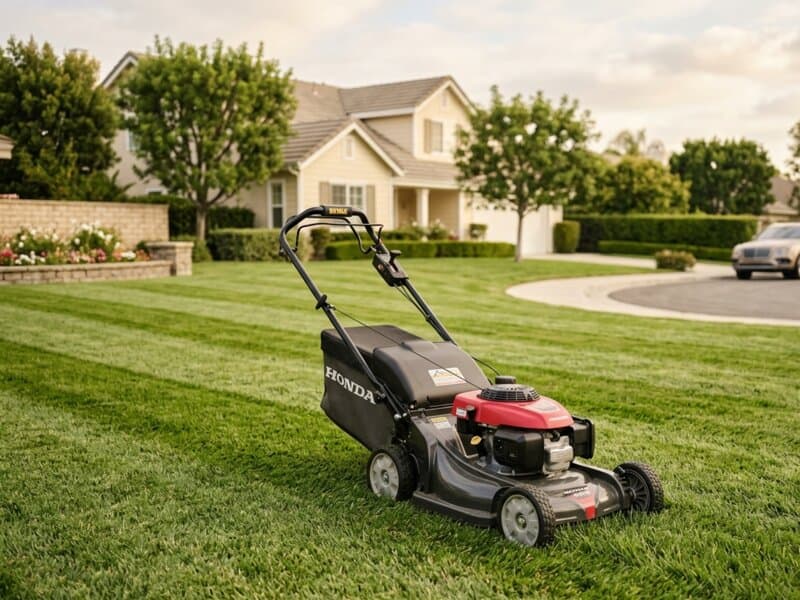
Walk your street on a Saturday morning and count the lawn mowers. Then count the pressure washers, the extension ladders, the carpet cleaners hauled home from a rental counter twice a year. Almost every one of them sits idle nearly all year, and almost every one of them was bought new.
None of that is irrational on its own. Nobody wants to knock on a stranger’s door to borrow a chainsaw. But the aggregate is genuinely strange: a dozen households each spending four figures on equipment that, between them, could be covered by one of each.
The list
Twelve things that come up over and over, with a realistic new-ish price and what your share looks like if six households go in together.
| Item | Typical price | Your share across 6 homes |
|---|---|---|
| Lawn mower | $420 | $70 |
| Pressure washer | $350 | $58 |
| Carpet cleaner | $320 | $53 |
| Extension ladder | $250 | $42 |
| Wheelbarrow | $150 | $25 |
| Hedge trimmer | $180 | $30 |
| Chainsaw | $260 | $43 |
| Tile saw | $300 | $50 |
| Party tent and folding tables | $500 | $83 |
| Outdoor pizza oven | $600 | $100 |
| Projector and screen | $450 | $75 |
| Leaf or snow blower | $340 | $57 |
- To buy all twelve yourself
- $4,120To buy all twelve yourself
- Your share of one of each
- $687Your share of one of each
- Difference, per household
- $3,433Difference, per household
That is not a rounding error, and it is not a lifestyle sacrifice. Every household still gets a mower, a ladder and a pizza oven. They just stop buying six of each.
Why these twelve and not others
The list isn’t arbitrary. Things that share well have four traits in common:
- Used occasionally, not daily. A few times a year is the sweet spot. Anything you touch every morning should be yours.
- Expensive enough to bother. Under about $80, the coordination costs more than the savings.
- Portable, or in a fixed spot everyone can reach. If moving it needs a truck, the share only works among close neighbors.
- Not needed by everyone at the same moment. This is the one people get wrong, and the reason most sharing arrangements quietly die. The snow blower on the list above is the clearest case, and we wrote up why it fails.
What not to share
Being honest about the exceptions is what keeps a share alive for years instead of weeks.
- Anything you might need at 6am on a weekday with no notice.
- Anything expensive that a careless afternoon can destroy, unless you have already agreed who replaces it.
- Cheap consumables and anything you would feel weird handing back, since the savings are too small to be worth the etiquette.
- Safety-critical gear you cannot personally inspect before use, like climbing rope or a car seat.
How to start without calling a neighborhood meeting
Nobody has ever successfully launched a twelve-item equipment library from a standing start. Do it in the order that keeps the risk near zero:
- Start with three neighbors, not thirty. People you already wave to. Trust does not scale before it exists.
- Start with one item. Ideally one somebody already owns and is happy to put into the pool, so nobody spends money to find out if this works.
- Put it on a calendar everyone can see. Not a text thread. A thread has no memory and no fairness.
- Agree the three boring rules up front: return it clean, return it fueled, and whoever breaks it replaces it.
- Add a second item only once the first has gone a full season without friction.
The part that compounds
The money is the obvious win, but the second-order effects are bigger. Garages get emptier. The thing you need at 9am on Sunday turns out to be four doors down instead of a 40-minute round trip to a rental counter. And once three households have shared one mower for a season without a single awkward conversation, the twelfth item is an easy yes.
That is the whole reason we built AllDibs: the money math on sharing has always been obvious, and the scheduling has always been the thing that breaks. Give every household a fair budget of weekend and midweek days, let a calendar say “that Saturday is taken” instead of a person, and the list above stops being a nice idea. Set up your first shared item. It’s free.