The drill you use twice a year is the most expensive tool you own
Sticker price is the cheapest part of owning a rarely used tool. The real cost-per-hour math on a typical garage, and why the mower you resent is the best deal in it.
The AllDibs team
3 min read
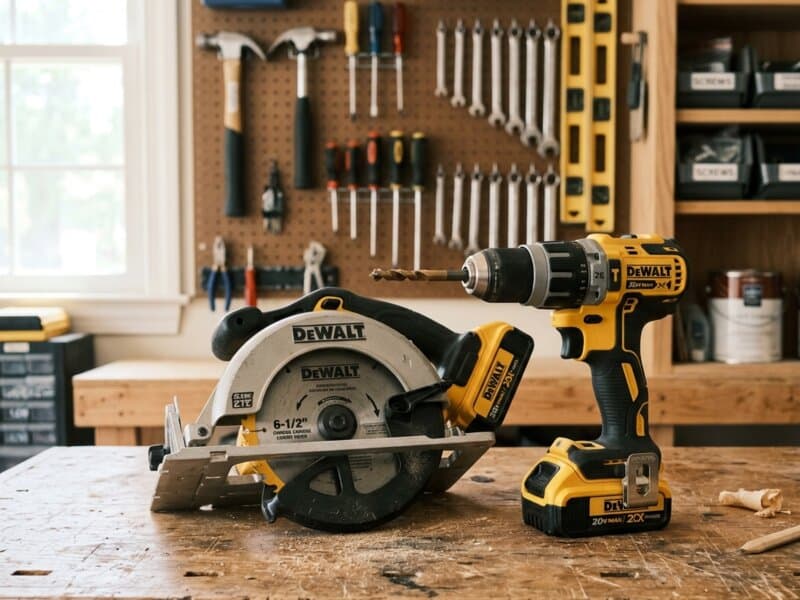
Go and stand in your garage, and ask a different question than usual. Not what everything in there cost, you probably remember that, but how many hours each thing actually ran last year. The answers tend to be humbling, and they completely invert which tools feel expensive.
Sticker price is a deposit, not the price
We treat buying a tool as a one-time payment, which is why the math stays comfortable. It is not one payment. Over a decade, the purchase is joined by:
- Depreciation, quietly, from the moment the box opens.
- Batteries that age whether you use them or not. A cordless kit used twice a year often needs a $70 pack before it needs anything else.
- Consumables and fuel: blades, oil, filters, line, gas that goes stale in the can.
- Servicing for anything with an engine, which is due on a schedule that has no interest in how often you used it.
- Storage. Garage square footage is not free. It is just already paid for, which is why it never enters the calculation.
- The second purchase. The cheap one that disappointed you, and the good one you bought afterward.
The real number: cost per hour
Add the purchase to a decade of upkeep, then divide by the hours the thing will genuinely run in that decade. Six typical garage residents, with honest usage:
| Tool | Purchase + 10 yrs upkeep | Hours a year | Cost per hour |
|---|---|---|---|
| Lawn mower | $470 | 26 | $1.80 |
| Chainsaw | $320 | 4 | $8.00 |
| Cordless drill kit | $250 | 3 | $8.30 |
| Pressure washer | $410 | 4 | $10.25 |
| Carpet cleaner | $360 | 3 | $12.00 |
| Tile saw | $310 | 1.7 | $18.20 |
Swipe the table sideways to see every column.
The mower, the thing you resent, that eats your Saturdays, that always needs something, is by a distance the cheapest tool in the garage at $1.80 an hour. The tile saw you were rather pleased about costs ten times that per hour. The five tools that are not the mower add up to $1,650 and run about sixteen hours a year between them.
- In tools that run 16 hours a year
- $1,650In tools that run 16 hours a year
- Average real cost per hour
- $10.50Average real cost per hour
- The same hour, split four ways
- $2.60The same hour, split four ways
Why the expensive stuff hides so well
Three reasons, all of them about psychology rather than money.
First, we pay once and feel the cost once, then use the thing for a decade with no further reminders. Second, owned things feel free at the point of use. There is no meter running, so a two-hour job with your own saw registers as costing nothing. Third, once you own it, you stop shopping. You will never again compare that tile saw against the $40 rental, because you already have one, and comparison would only produce regret.
A fifteen-minute garage audit
Worth doing once, ideally before your next tool purchase.
- List everything in there that cost more than $100.
- Beside each, write the number of times you used it in the last twelve months. Be honest; nobody is watching.
- Circle everything with a count of two or less.
- Add up the circled purchase prices. That is your idle capital.
- For each circled item, ask one question: does anyone within four doors of me own one too?
That last question is the whole point. Sharing does not make a tool cheaper to own. It changes what you are dividing. Four households buying one $310 tile saw instead of four spend $78 each, and every one of them still gets the saw for their bathroom project. The cost per hour drops from $18.20 to $4.55 without anyone giving anything up.
Start with the most expensive hour
Do not try to reorganize the whole garage. Take the single item with the worst cost per hour, usually something specialized you bought for one project, and offer it to three neighbors as a shared tool. Then put it on a calendar, so “can I borrow the saw next weekend?” stops being a favor anyone has to ask.
That is what AllDibs does: one page per shared thing, one invite link, and a fair budget of midweek and weekend days for everyone so no one person books every dry Saturday. It’s free for your first five items. If you want the general version of this math, read cost per use.