Cost per use: the one number to run before you buy anything
A four-part formula, an honesty rule that halves most people's usage estimates, and the threshold that decides between renting, buying, and splitting it four ways.
The AllDibs team
3 min read
Almost every purchase over $100 comes down to a single number, and almost nobody works it out. Not the price. The price per use, because a $600 machine you use weekly is cheap, and a $200 one you use twice is not.
The formula
(price + running costs − what you can resell it for) ÷ (honest uses per year × years you will keep it)
Four terms, and three of them are the ones people skip. Running costs are everything the thing needs to stay usable: fuel, filters, solution, a battery in year five, an annual service. Resale is what it is worth when you are done, which for most consumer gear is a small fraction of what you paid. And years you will keep it is usually shorter than the warranty implies, because you will move, or the standard will change, or it will sit in a box.
The honesty rule: halve your estimate
The denominator is where every one of these calculations goes wrong. People do not estimate future usage; they estimate their intentions. This is the same instinct that sells gym memberships in January and bread makers in December.
A worked example, honestly
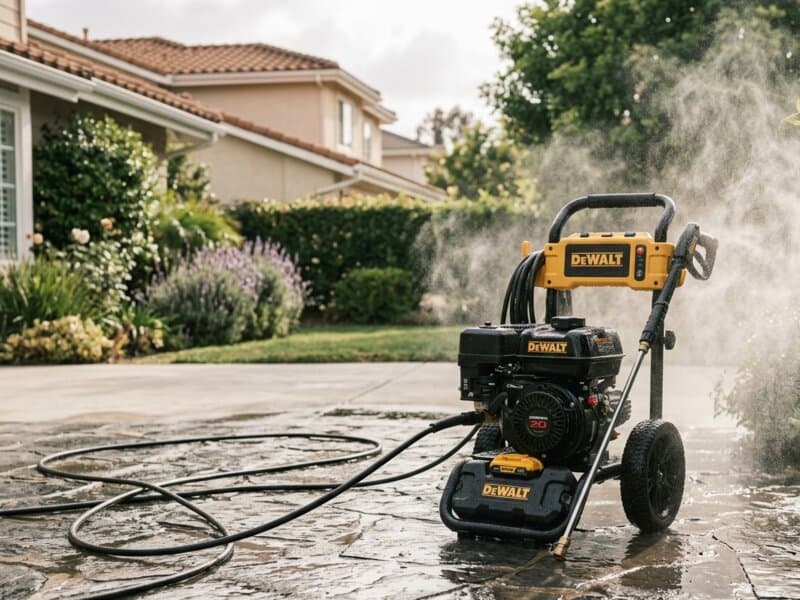
A pressure washer. $350 to buy, and over eight years maybe $60 of detergent, pump oil and a winterizing kit. Sell it at the end for $40. That is $370 all in. Honest usage: twice a year, spring driveway and fall deck. Sixteen uses over eight years.
$370 ÷ 16 = about $23 a use. Now the interesting part: renting one costs about $65 a day, so twice a year is $130 a year against an ownership cost of $46 a year. Buying wins, comfortably. The honest cost-per-use math does not always say “don’t buy”, and that is exactly why it is worth running rather than assuming.
But run the third column and the picture changes again.
| Pressure washer, 8 years | Rent it | Buy it | Share it 4 ways |
|---|---|---|---|
| Total cost to you | $1,040 | $370 | $93 |
| Cost per use | $65 | $23 | $5.80 |
| Uses you get | 16 | 16 | 16 |
| Storage | None | Your garage | One garage of four |
Swipe the table sideways to see every column.
Sharing wins by a factor of four, and it wins for a reason worth internalizing: it divides the numerator without touching the denominator. You still use the washer twice a year. You just stop paying for the other 363 days it sits still.
Four thresholds worth memorizing
- Fewer than ten uses over its whole life? Do not buy it alone. Rent it or split it.
- Cost per use above half a day’s rental? The rental counter is beating you, even with the trip there and back.
- Fixed annual costs like insurance, storage, a service contract or a slip fee? Treat it as a subscription, because that is what it is, and subscriptions are exactly what splitting four ways fixes.
- Cost per use under about $2? Stop optimizing and buy the thing. Your time is worth more than the spreadsheet.
Where this changes how you shop
Once you run this a few times, two habits stick. You stop buying the pro-grade version of things you use twice a year, because doubling the price doubles the cost per use for capability you will never reach. And you start noticing which purchases are really group purchases wearing a disguise: the trailer, the tent, the tile saw and the rest of the garage, the boat.
- Run the number before you buy, not after.
- Use last year’s actual count as the denominator.
- Add the running costs, including the ones that accrue while it sits idle.
- If the answer is ugly, ask two neighbors before you ask the store.
If you get as far as asking the neighbors, the only remaining problem is whose weekend it is, which is the problem AllDibs was built to solve. For the full breakdown on a bigger purchase, see the math on splitting a boat four ways.