Rent, buy, or share? A decision guide for expensive gear
Rental counters hide the fees, ownership hides the upkeep, and sharing hides the scheduling. Three questions that tell you which one is actually cheapest.
The AllDibs team
4 min read
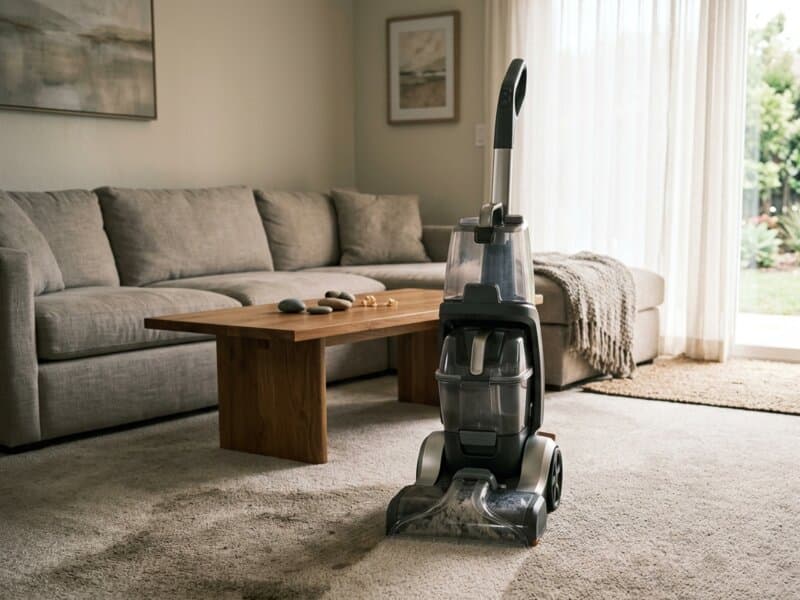
You need a carpet cleaner this weekend. You can rent one for $45 a day, buy one for $320, or text three neighbors and split one. Most people decide this on vibes, at 9pm, on a product page. It deserves about four minutes of arithmetic, because the gap between the best and worst option is usually a few hundred dollars.
Start with three questions
- How many times will you genuinely use it in the next five years? Not how many you can imagine. How many happened in the last five.
- Does it need to be available with no notice? A burst pipe and a shampooed rug are different urgency classes.
- Where will it live? If the answer is “the garage, where the car goes,” that is a real cost you have not counted yet.
Those three answers point at one of the three options almost every time. The table below is the same three options priced out over five years, using that carpet cleaner as the example.
The three options, side by side
| Carpet cleaner, 5 years | Rent | Buy | Share with 3 others |
|---|---|---|---|
| Cost over 5 years, 2 uses a year | $450 | $350 | $88 |
| Cost per use | $45 | $35 | $8.80 |
| Available at short notice | Usually, not weekends | Always | Needs a calendar |
| Storage | None | A garage corner | Somebody’s corner |
| Upkeep and repairs | Not yours | Yours | Split |
| Best when | You need it once, ever | You use it monthly | A few times a year |
Swipe the table sideways to see every column.
Two things stand out. Renting is the worst option for anything cheap to own: you pay a day rate forever and never build up a thing. And the gap between buying and sharing is not small: four households buying one cleaner instead of four spend $1,050 less, and each of them still cleans their carpets twice a year.
What the rental counter leaves off the shelf tag
- The advertised rate is often a 4-hour rate. Check the full-day price before you plan around the headline number.
- Weekend premiums, on exactly the days you can actually use the thing.
- A damage waiver, a percentage of the rental added at the counter, optional in theory and firmly recommended in practice.
- Fuel, solution or blade charges settled when you return it, not when you book it.
- A deposit hold on your card, sometimes for the full replacement value.
- You have to go get it. Two trips, often needing a vehicle you may not own, is 90 minutes of the weekend you were trying to save.
What the box leaves off too
Ownership hides its costs in the opposite direction: not up front, but spread out where you will never add them up.
- Servicing and consumables that accrue whether or not you use it: oil, filters, belts, solution, blades.
- Batteries that age on the shelf. A cordless tool used twice a year often needs a $70 pack before it needs anything else.
- Storage. Square footage in a garage is not free; it is just already paid for.
- Depreciation, which is the largest line on anything with an engine.
- Disposal, eventually, which for anything with a battery or a motor is rarely free.
And what sharing does not tell you
In fairness: the money case for sharing is so strong that it is worth being blunt about where it goes wrong. It is never the money. It is two things.
First, somebody hogs the good days. Not maliciously. They are simply the most organized person in the group, and they book every dry Saturday in April. Second, nobody knows where the thing is. It was last at Dave’s, or possibly Dave lent it to his brother.
The quick version
- Once, ever, and it is heavy or specialized: rent it.
- Weekly or monthly: buy it. Frequent use makes ownership the cheapest per use, every time.
- A few times a year, and neighbors want it too: share it.
- A few times a year and nobody nearby cares: buy the cheap version, not the pro one.
- It needs insurance, licensing, a slip fee, or a service contract: share it, with something written down. Fixed annual costs are what make solo ownership brutal, and a boat is the usual example; here is how a shared boat works.
Setting up a share that lasts
- Pick one item to start, ideally one someone already owns.
- Agree who stores it, and that whoever stores it does not thereby own it.
- Agree the replacement rule before anything breaks, in writing, in one sentence.
- Put the calendar somewhere neutral that everyone can see without asking.
- Give every household the same fair budget of weekend days, the scarce thing, rather than first-come-first-served.
That last point is the one AllDibs exists for. Every member gets their own budget of midweek and weekend credits, booking a day spends one, and the credit comes back once the day has passed, so nobody can lock up a whole season, and no person has to be the one saying no. See how the credits work, or start with one item for free.